
A Better Way to Do SMRs: Lessons from a Compliance Veteran
Aaron Soh, former Global Head of Compliance at Novatti Group, shares insights on improving Suspicious Matter Reports. BNDRY is designing tools to streamline SMR submissions while maintaining the human intelligence that regulators value.
Suspicious Matter Reports (SMRs) serve as critical intelligence tools in fighting financial crime globally. Aaron Soh, former Global Head of Compliance at Novatti Group and current Managing Director of Testudo Compliance Group, brings extensive experience in investigating and reviewing SMRs. His insights have shaped BNDRY’s approach to simplifying SMR submissions for designated service providers.
“Writing a good SMR isn’t just about meeting your obligations. It’s about showcasing your systems and ability to articulate a suspicion clearly and concisely with genuinely actionable intelligence.”
— Aaron Soh
SMRs in Context: The Frontline of AML/CTF Intelligence
AUSTRAC depends on designated service providers as its primary source of suspicious activity intelligence. Effective SMRs provide actionable insights that help authorities investigate money laundering and terrorist financing.
Submission timelines are strict:
- Terrorism financing: 24 hours
- Other offences: 3 business days
“Collaboration is key. AUSTRAC opening the door to sharing more is a good step. But it is still crucial that more collaboration doesn’t expose sensitive data and risk tipping off.”
— Aaron Soh
With Tranche 2 regulations, lawyers, real estate agents, accountants, conveyancers, and precious metal dealers will face SMR obligations alongside existing regulated entities.
SMRs Can Be Complex
Despite their importance, SMRs present significant practical challenges. Compiling a single SMR typically requires two hours or more, especially when gathering supporting documentation. The dense schema demands information scattered across multiple systems.
Regulated entities must retain all AML/CTF data — including SMRs — for seven years. Many organisations struggle with this requirement, resorting to screenshots or paper trails rather than secure, structured storage.
“The most valuable part of the SMR is well-explained grounds for suspicion. That’s where your thinking shows — not just what happened, but why it raised red flags.”
— Aaron Soh
How BNDRY Is Building SMRs
Smarter Forms for Frontline Capture
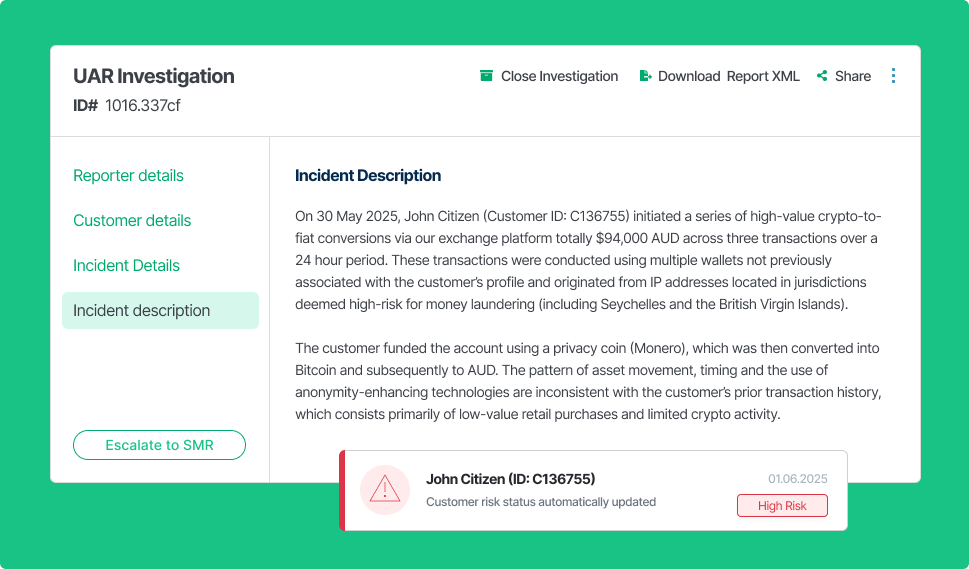
Configurable forms enable frontline staff across industries — banks, pubs, real estate agencies, digital platforms — to report unusual activity quickly, capturing the information necessary for proper investigation. Conditional logic means a form adapts to what staff actually report: a cash transaction triggers different follow-up questions than a structuring concern, so you capture the right detail every time.
A UAR to SMR Pipeline
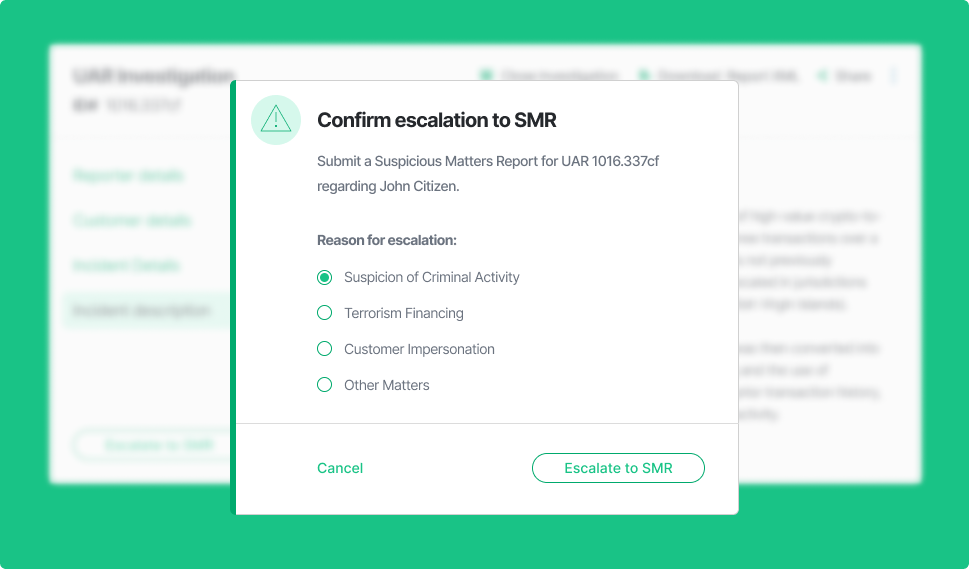
Unusual Activity Reports (UARs) escalate to SMRs when suspicion forms. Data automatically flows from UAR to SMR, eliminating duplicate effort. No double handling, no double entry.
Automated Data Enrichment
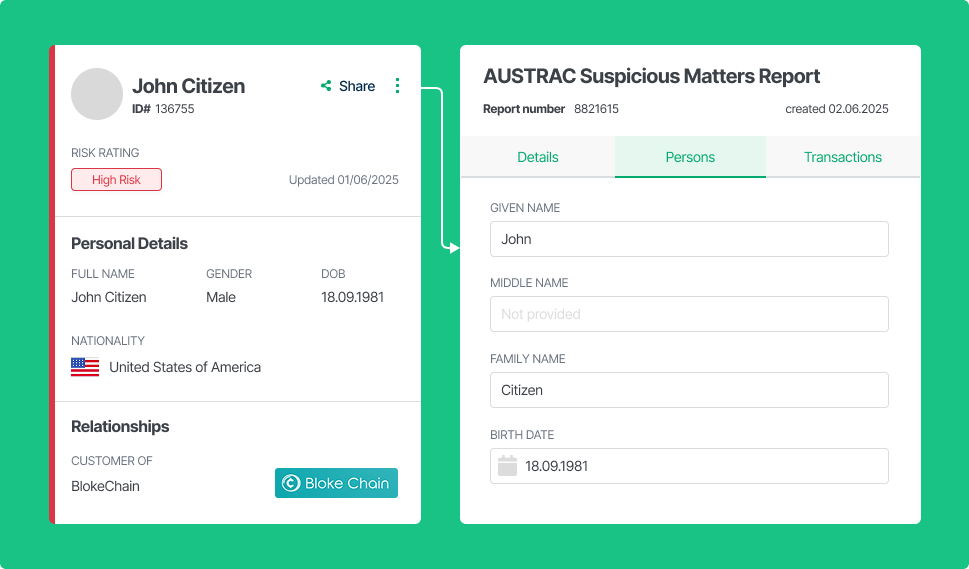
BNDRY pre-fills structured customer data — names, addresses, contact information, account details — from entity profiles. Integrations with transaction monitoring systems can pipe flagged patterns directly into SMR drafts.
“Pre-filling the basics means you’ve already won half the battle. It frees you up to think about what actually happened.”
— Aaron Soh
Structured, Secure Record-Keeping
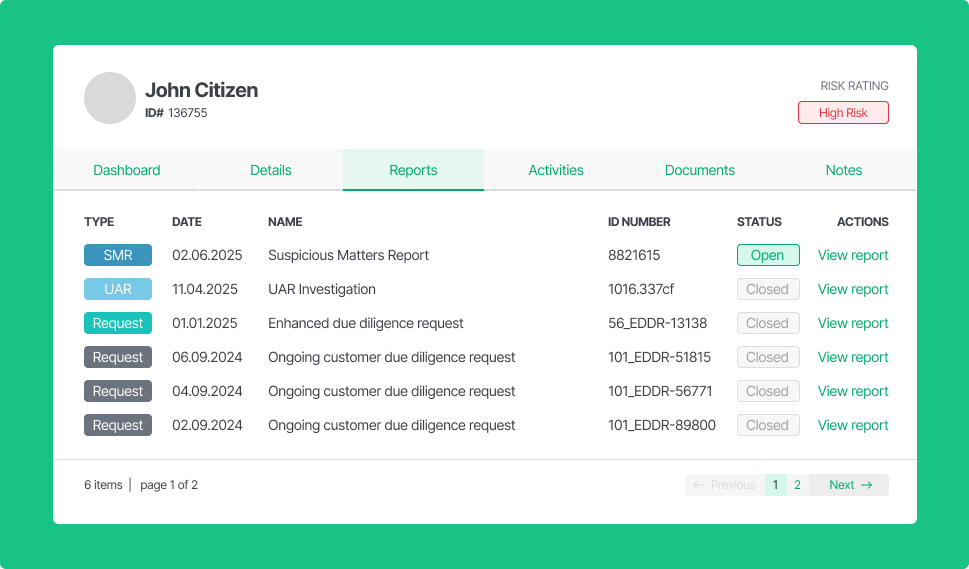
Every SMR and UAR is tracked within customer and entity records, satisfying seven-year retention obligations. Structured, queryable storage enables intelligence building over time, identifying patterns and triggering Enhanced Due Diligence based on activity thresholds.
Granular Access Control
SMRs contain sensitive customer information. BNDRY’s field-level access controls ensure only appropriate users view sensitive data, enabling team collaboration while protecting personal information.
The Bottom Line
BNDRY’s SMR design emerged from insights gained directly from compliance professionals managing real-world challenges — lengthy submissions, screenshot management, and deadline pressure. The platform accelerates SMR processes while preserving the human analysis that makes these reports genuinely valuable to regulators and law enforcement.
This article is intended as general information only and does not constitute legal advice.